
Termination atcarrier prices
Compare every listed route by rate and stated quality, connect one in a click and pay per call. Selling? Upload a rate sheet and reach every buyer on the marketplace.
In short
One account opens every route on the marketplace.
Each listing shows its rate, channel capacity, its ASR, ACD and NER measured on real buyer calls once it has carried enough of them, the ASR, ACD and PDD its seller states, and our Exchange Score: a 1 to 100 rating from those figures and the route's tier, which stays unrated until the route has carried real traffic. Connecting a route is free and issues SIP credentials or IP authorisation on the spot. You pay the seller's rate plus one platform fee: 0.5% over your own trunk or 2% through the API, capped at $0.001 per call either way.
What you can do
- 01
Voice termination
A-Z decks and single-country routes across direct, premium, standard and No CLI tiers.
- 02
SMS routes
A2P and P2P routes by country and operator.
- 03
Least-cost routing
Send each call down the cheapest route you hold. Failover to the next runs in route groups on the Switch.
- 04
Quality reports
Report a bad route; when the seller marks it fixed, it is re-tested automatically.
How buying works
From a free account to your first billed minute
No bilateral contract, no credit application and no minimum commitment stand between you and a route. Four steps, all of them in the dashboard.
Open and fund an account
The account is free. Top up from $5 by card or crypto, or from $100 by bank wire, and every trade draws from that one prepaid balance.
Filter every listed route
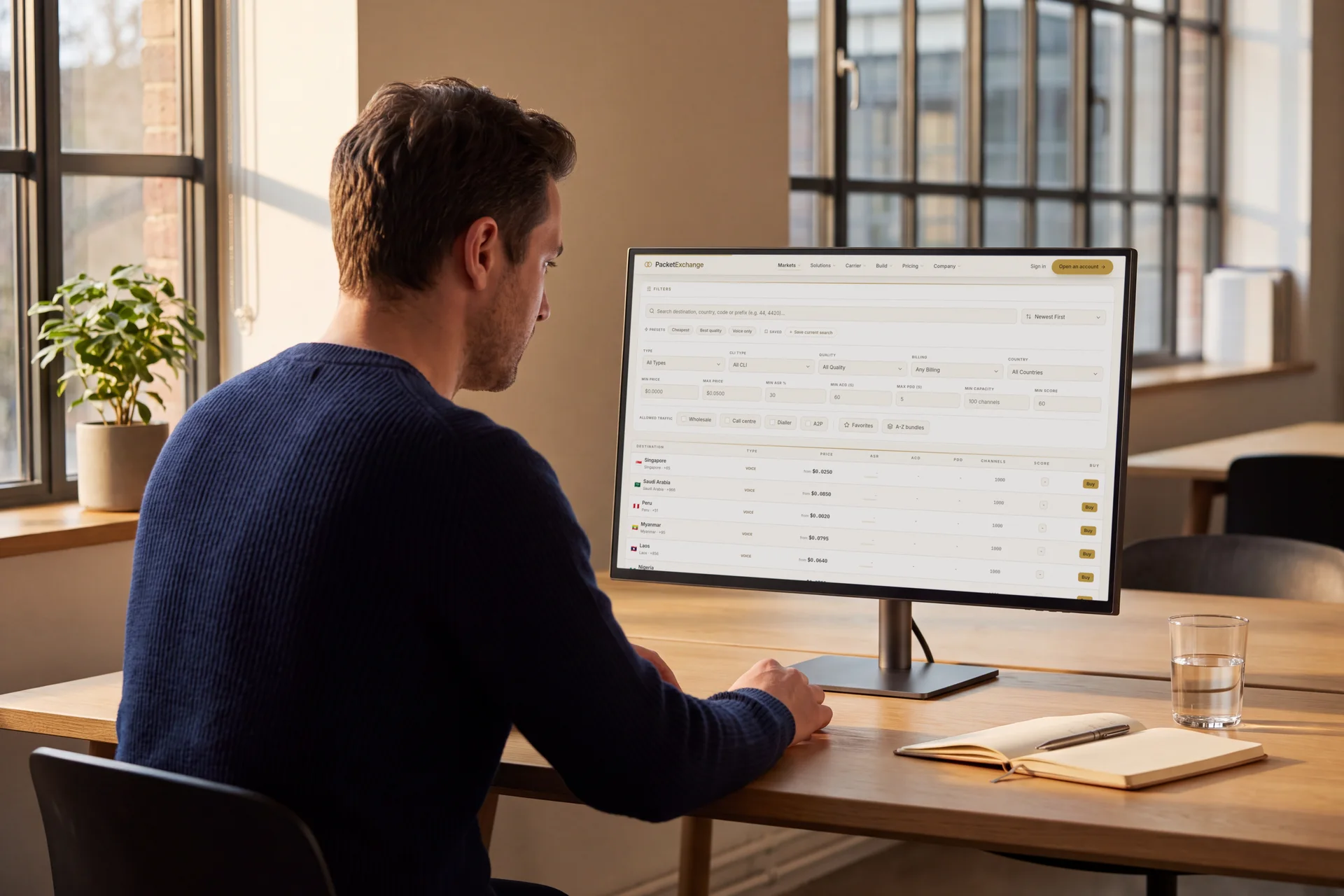
Narrow by destination or prefix, CLI type, quality tier, billing increment, rate, ASR, ACD, PDD, capacity and minimum Exchange Score, then sort by what matters for this traffic.
Connect it, or make an offer
Connecting a route costs nothing and issues its SIP credentials on the spot. Want a better rate? Make an offer, and if the seller accepts, the purchase is created at the agreed price.
Send calls, pay per call
Point your switch at your Switch IP and send traffic. Each call is billed when it ends, at the route rate plus a capped platform fee, straight from your balance.
Compare before you commit
Every route side by side, before a single call
The marketplace puts each listing on one line: destination, quality tier, CLI type, rate, the ASR, ACD and NER measured on real buyer calls once a listing has carried enough of them, the ASR, ACD and PDD its seller states, capacity and Exchange Score. Sort by rate when margin is the brief, or by measured quality or score when completion is. A multi-country A-Z deck lists as one route per country, priced from its cheapest rate, with every destination and prefix one click away. What you will not find is a seller column. On PacketExchange you buy the route, not a relationship.
- The Exchange Score, 1 to 100, reads "New" until a route has carried real calls, so no listing starts with a number it has not earned.
- Star routes to a watchlist, save the searches you run every morning and compare up to four routes side by side.
- Filter by the traffic a seller accepts: wholesale, call centre, dialler or A2P.
- Open any A-Z deck as a searchable table, by country or by prefix, before you connect it.
Sort Best Exchange Score
- Type
- Voice
- Min ASR
- 35%
- Max PDD
- 4s
- Min capacity
- 200 ch
| Destination | Quality | Rate | ASR | ACD | PDD | Score | Action |
|---|---|---|---|---|---|---|---|
UK Mobile 447 | Operator direct Full CLI | $0.0124 | 52% | 3m 10s | 1.9s | 88 | Connect |
UK Mobile 447 | Premium Full CLI | $0.0109 | 47% | 2m 41s | 2.4s | 81 | Connect |
UK Mobile 447 | Standard Mixed CLI | $0.0086 | 41% | 2m 05s | 3.1s | 67 | Connect |
UK A-Z Per destination | No CLI No CLI | $0.0019 from | 38% | 1m 48s | 3.6s | 58 | Connect |
UK Fixed 441, 442 | Premium Full CLI | $0.0021 | 55% | 3m 32s | 1.6s | New | Connect |
Showing 5 of 5 routes. Rates are per minute, before the platform fee. Score: first-party 1 to 100 quality rating, unrated until the route carries traffic.
Negotiate in the product
Make an offer and let the seller answer
List price is where the conversation starts. Offer your rate on any single-price route and the seller can accept, counter or decline, turn by turn, with every move on a timeline both sides can read. When an offer is accepted, the purchase is created at the agreed price in the same step, so the rate you settled on is the rate every call is billed at. Buying across several destinations? Send one offer over a whole selection and each route negotiates on its own.
- One open offer per route at a time, so there is never a doubt about which price is on the table.
- If the seller reprices, pauses or removes the route mid-negotiation, the offer closes and you are told, so you never buy on stale terms.
- Offer messages cannot carry contact details, so the negotiation stays on the exchange.
- An accepted offer issues SIP credentials exactly as a direct purchase does.
United Kingdom Mobile
Premium · Full CLI · Billed 1/1
List
$0.0124Opened
$0.011Agreed
$0.0118Negotiation
Buyer opened at $0.0110
Tue 09:12“Steady daytime traffic, ready to start this week.”
Seller countered at $0.0118
Tue 11:40Buyer accepted at $0.0118
Tue 11:52
Purchase active at the agreed rate
Every call on this route bills at $0.0118 per minute. SIP credentials were issued with the purchase.
Selling on the exchange
Upload one rate sheet, reach every buyer
Listing a route starts with the file you already send to customers. Upload a CSV or Excel rate sheet and the listing fills itself in: destinations, prefixes, rates and billing increments, parsed from your own rows. You add what a sheet cannot say, such as CLI handling, quality tier and your SIP endpoint, and a real SIP probe checks that endpoint before you go live. A deck that spans many countries publishes as one listing per country, so buyers find each destination on its own line.
- Buyers see "Marketplace seller" with your verification and score, never your company name or your endpoint.
- Every billed call credits your carrier rate to your balance. The platform fee is paid by the buyer on top.
- Keep a route private and grant it to chosen buyers, with a custom rate for each one if you like.
- Withdraw your balance by crypto or bank wire from $50.
- Type
- Destination
- Pricing
- Endpoint
- 05Verify & go live
Rate sheet
acme-rates-september.xlsx
Rates
1,284Countries
41From
$0.0019Every rate is read from your file. ASR, ACD and PDD are yours to state; nothing is guessed.
Endpoint check
- Endpoint198.51.100.40:5060
- Real SIP INVITE from our media addressesAnswered
- ResultPass
41 country listings, published from one sheet
Buyers see
Marketplace seller · Verified
Built into the marketplace
Everything a wholesale buyer needs, on one screen
The tools buyers and sellers reach for every day, working on the same listings and the same prepaid balance.
Filters that match how carriers buy
Search by destination, country, dial code or prefix. Filter on CLI type, tier, per-second or per-minute billing, rate range, minimum ASR and ACD, maximum PDD, capacity and minimum score.
The Exchange Score
Our own 1 to 100 rating, calculated from the route's quality tier and its measured ASR, NER, ACD and PDD once it has carried enough recent calls, or from the figures its seller states until then. A route stays unrated until it has carried real traffic, and the whole marketplace sorts and filters by it.
A-Z decks, a country at a time
A multi-country rate sheet lists as a route per country. Each shows its lowest rate as "from", and calls are billed on the longest matching prefix in the deck.
Offers and bulk offers
Offer below list on one route, or send a single offer across a selection. Every negotiation keeps its own turn-by-turn timeline and closes on its own terms.
Private routes and custom rates
Sellers can keep a route off the public marketplace and grant it to chosen buyers, optionally at a rate set for each buyer. Buyers can request access to a private route.
Watchlist, saved searches, compare
Star the routes you track, save the filters you run every day, and lay up to four routes side by side before you choose.
Messages that stay anonymous
Once you have bought a route or made an offer, message the route owner in the product. They see you as "Buyer #" and a short code, and contact details are refused.
Route reports with a re-test
Report a failing route with the call record attached. When the seller marks it fixed, the exchange re-tests their endpoint automatically and tells you whether it passed.
Why trade here
Better margin, faster supply, less exposure
A marketplace only earns its place if it beats phoning round for rates. These are the four ways this one does.
Margin kept on every minute
You pay the rate the seller lists, or the rate you negotiated, plus one fee with a ceiling: 0.5% over your own SIP trunk, 2% through the API or Dialer, never more than $0.001 per call. No setup fee, no monthly minimum, no commitment.
Supply in minutes, not a contract cycle
There is no agreement to draft and no IP exchange to schedule before you can try a destination. Connect a route and its credentials exist at once. Add the next destination by connecting another route over the same trunk.
Quality on the listing, and a way to hold it
Every listing states its seller's ASR, ACD, PDD and capacity, the Exchange Score is only earned on real traffic, and your own answer rate and call length are tracked for every route you buy. When a route slips, a report and an automatic re-test do the chasing.
Both sides stay anonymous
Buyers compare routes, not carriers, and sellers see buyers only by pseudonym. Neither side ever receives the other's SIP endpoint. Sellers list without exposing their supply, and every trade, credential and payment runs through the exchange.
Before and after
Wholesale buying, without the back and forth
- Finding supply
- The usual way: Rate sheets by email from each carrier, merged by hand into a spreadsheet
- On PacketExchangeEvery listed route in one marketplace, filtered and sorted in seconds
- Getting connected
- The usual way: A contract, a credit check and an IP exchange for every new supplier
- On PacketExchangeA free account and a prepaid balance, with credentials issued when you connect the route
- Judging quality
- The usual way: A rate sheet that says nothing about completion
- On PacketExchangeStated ASR, ACD, PDD and capacity on every listing, plus a score only earned on real calls
- Agreeing a price
- The usual way: Negotiated over email, then checked against the invoice
- On PacketExchangeOffered and countered in the product, and the accepted rate is the billed rate
- Paying
- The usual way: Deposits, minimum commitments and a monthly invoice to reconcile
- On PacketExchangeBilled per call from your balance, with no minimum
- When a route fails
- The usual way: A ticket to the supplier, and a wait
- On PacketExchangeA report with the failed call attached, and an automatic re-test when the seller marks it fixed
- Selling
- The usual way: A contract and an onboarding for every buyer
- On PacketExchangeOne listing every buyer on the exchange can connect, paid from prepaid balances
| The usual way | On PacketExchange | |
|---|---|---|
| Finding supply | Rate sheets by email from each carrier, merged by hand into a spreadsheet | Every listed route in one marketplace, filtered and sorted in seconds |
| Getting connected | A contract, a credit check and an IP exchange for every new supplier | A free account and a prepaid balance, with credentials issued when you connect the route |
| Judging quality | A rate sheet that says nothing about completion | Stated ASR, ACD, PDD and capacity on every listing, plus a score only earned on real calls |
| Agreeing a price | Negotiated over email, then checked against the invoice | Offered and countered in the product, and the accepted rate is the billed rate |
| Paying | Deposits, minimum commitments and a monthly invoice to reconcile | Billed per call from your balance, with no minimum |
| When a route fails | A ticket to the supplier, and a wait | A report with the failed call attached, and an automatic re-test when the seller marks it fixed |
| Selling | A contract and an onboarding for every buyer | One listing every buyer on the exchange can connect, paid from prepaid balances |
Built for
Who runs traffic on it
Carriers and resellers
Buy termination for your customers and resell it at your own margin.
Aggregators
Add a second route per destination and bring your average cost down.
Route sellers
List spare capacity once and sell it to every buyer on the marketplace.
Pricing
The seller's rate, plus one capped fee
- fee over your own SIP trunk
- 0.5%
- fee through the API or Dialer
- 2%
- fee cap per call
- $0.001
Every call is billed when it ends: the route rate, or the rate you negotiated, for the billable seconds under that route's increment, plus a platform fee. The fee is a percentage of the carrier rate with a hard ceiling, so it can never exceed $0.001 per call.
There is no setup fee to connect a route, no monthly minimum and no volume commitment. Listing a route costs sellers nothing: the fee is paid by the buyer, on top of the seller's rate.
What you pay for
Over your own SIP trunk
0.5% of the carrier rate, capped at $0.001 per call.
Through the API or the Dialer
2% of the carrier rate, capped at $0.001 per call or message.
Prepaid balance
Top up from $5 by card or crypto, or from $100 by bank wire. Over your trunk, a call can never run longer than your balance covers.
Seller earnings
Your carrier rate is credited on every billed call. Withdraw from $50 by crypto or bank wire; balance from card top-ups is held for 7 days first.
Each route states its billing increment, such as 1/1, 6/6 or 60/60, before you connect it.
Questions buyers and sellers ask
Buying and selling routes, answered
The questions buyers ask before they start. Anything not covered here is in the help centre, or ask the team directly.
Can I see which carrier is selling a route?
No. A listing shows the route: destination, quality tier, CLI type, rate, ASR, ACD, PDD, capacity and Exchange Score. The seller appears as "Marketplace seller" with their verification status and average score. Sellers see buyers by pseudonym too, and neither side ever receives the other's SIP endpoint. The one exception is a Connect introduction, which two members make deliberately, usually in person.
What is the Exchange Score?
Our own 1 to 100 rating for a route, calculated from its quality tier and its measured ASR, NER, ACD and PDD once it has carried enough recent calls, or from the figures its seller states until then. It appears only once the route has carried real traffic; until then the route reads "New". You can sort the marketplace by score or set a minimum.
Does it cost anything to connect a route?
No. Connecting a route is free and issues its SIP credentials straight away. You pay only when traffic flows: per call, at the route rate plus the capped platform fee.
How do I send traffic to a route I have connected?
Whitelist your switch's public IP, or use the SIP username and password issued with the purchase, and point your trunk at your Switch IP on port 5060 over UDP or TCP with G.711a, G.711u or G.729. Every setting sits on one page of your dashboard.
Can I negotiate on an A-Z deck?
Offers apply to routes with a single price. An A-Z deck bills each destination on its longest matching prefix, so one negotiated figure could not be honoured, and the product will not accept an offer on it.
Are there extra checks for US routes?
Yes. Buying a US voice route needs a complete STIR/SHAKEN compliance profile first, and the purchase is reviewed and approved before it can carry traffic.
What happens when a route I bought stops working?
Report it from the dashboard with the failed call attached, and a live SIP trace if you want one. The seller is notified under a pseudonym. When they mark it fixed, the exchange re-tests their endpoint and tells you the result, and you can confirm, reopen or escalate to our support team.
How do sellers get paid?
Each billed call credits the seller's carrier rate to their balance as the call is settled. That balance can be withdrawn from $50 by crypto or bank wire.